No women bishops for the C of E

Thursday, 22 November 2012


There was disappointment and anger for many Christians on Tuesday when the General Synod of the Church of England narrowly voted not to appoint women as bishops.

There were 322 votes in favour of measures that would finally allow women to be bishops, and only 124 against. All but two of the Church's 44 dioceses had given their support. But a complicated voting system, requiring the support of at least two thirds of each of the three different sections of the synod - bishops, clergy, and laity (regular, non-ordained members of the church), meant that thanks to just six votes, the "nos" triumphed. There were large majorities among the bishops and the clergy, but "just" 64% of the laity voted "yes".

When you look at the overall spread of votes and the overwhelming support of senior members of the church, the outcome seems ridiculous and unfair. That evening, many of my Anglican friends - both men and women - were extremely upset by it all. There were tears shed by many present at the meeting when the results of the vote were announced. Such a narrow loss after so many years of discussion, campaigning, and heartache is a huge blow. As a statement from pro-women bishops group WATCH said:

"The vote is a missed opportunity for a whole generation to see men and women sharing fully in the mission, ministry and leadership of the Church of England".

Media reaction to yesterday's news has been a mixed bag. As well as helpful comment from those affected by it, there has been much talk of Christianity proving itself to be "irrelevant", obsessed with tradition and sexism at a time when it should be more forward-thinking - which totally ignores the fact that the Church of England establishment does not represent all Christians. There has also been much talk of "evangelicals" holding firm on a "no" vote when it is completely inaccurate to suggest that being evangelical is synonymous with a view that men and women have different "roles" in the church and in the world.

You wouldn't know it from looking at many media sources, but there are actually many churches that affirm the role of women as being able to serve and contribute to the church in the same way as men. They could sometimes do with focusing more on how they arrived at this decision, because in a secular world where equal opportunities and fairness are key, it's theological arguments that are of primary importance to most Christians involved - that is to say, what does the Bible say about men, women, and equality, and how should this be applied to the church today?

That's why it was particularly disappointing to see a piece by Jemima Thackray in the Telegraph yesterday, claiming that "feminist rhetoric" irrevocably damaged the campaigning of those who are pro-women bishops.

"My main concern was that some arguments for women bishops just sounded too much like a contrived government initiative to get women into the boardroom," she wrote, mentioning the fact she thought the debate had become about "women having authority for its own sake" when the clergy are meant to be servants. She used words like "power hungry" and "status" as if that's what was at stake for the thousands of campaigners hoping for a "yes" on Tuesday.

This could not be further from the truth. Those in favour of women becoming bishops have always made a strong case for themselves, based on the equality of men and women in the eyes of God that's evident in the Bible and also on the radical example set by Jesus and the early church in giving authority and dignity to women that was, at the time, unheard of.

Over the centuries the church may have bought wholesale into the patriarchal way societies have generally been run, but that's not how it all began. Thousands of women clergy are very ably leading churches across the country because they feel that's what they've been called to do and because they love to serve their community, not because they're "power hungry". As Lucy Winkett said in her piece for the Guardian, linked above:

"For me, though, the issue is clear: from the very beginning of the church's existence, women should have been together with men in every area, every layer, every activity of the church's life. However, in the first century AD the church followed wider society, conforming to a societal structure that gave men the power."

Throughout this debate, it has been voices from outside the church that have ran with the rhetoric of "getting with the times" and equality legislation. This is not wrong - equality and inclusion were central aspects of Jesus's ministry - but it misses out on a vital perspective and in turn positions the debate on women bishops as one that should be decided on secular terms. Yes, many campaigners would consider themselves feminists and by opposing patriarchal power structures then they certainly have a lot in common with the feminist movement - but to claim they appeared motivated by status is out of line, and a sadly common view leveled at women who speak out against injustice and feel called to lead.

Broadcaster and popular blogger Vicky Beeching, who's also a research fellow in Christian ethics at Durham University, spoke to BitchBuzz on Wednesday. Of the tension between scripture and equality, she said:

"As a Christian Feminist who strongly campaigned for the women bishops vote to go through, I got my fair share of criticism. People often criticise my passion for gender equality, assuming that my feminism is rooted in a desire to be 'relevant' to today's culture. For me it's actually rooted in the Bible, because in that book I see a God who values women and men completely equally.

"Yes, the Bible has a reputation for being patriarchal, but I don't feel that is an accurate interpretation of it. For me, Christianity is best modelled in the life of Jesus and he treated women in ways that were considered revolutionary for his era. To me, he is the ultimate feminist."

Where the secular perspective matters here is for the general public who may be occasional churchgoers, or considering checking out church for the first time. Complex theological wrangling means little to them - they may just see a denomination that's anti-woman and more concerned about minute doctrinal detail than actually making a difference in people's lives, and this is never a good thing.

What's important right now is that the church shows love and support for its women clergy, attempts to move forward, and stands up to secular accusations that it is "dead", "irrelevant" and "bigoted", in the period before the measure can be discussed again in 2015. The "pro" camp must be united over proposals in order to stand firm against those opposing women bishops. As the next Archbishop of Canterbury, Justin Welby, said on Tuesday:

"It is time to finish the job and vote for this measure. But, also, the Church of England needs to show how to develop the mission of the church in a way that demonstrates we can manage diversity of view without division."

Further reading: A useful Q&A on this week's events A good but very indepth post on the theological debates surrounding the issue

This post originally appeared on BitchBuzz

Review: A Year of Biblical Womanhood

Tuesday, 13 November 2012


Biblical womanhood. It's a phrase and a concept that doesn't sit well with many Christians, thanks to the way it's been held over women and used to dictate their life choices in recent decades. For a long time, those two words together made me bristle with irritation at the way they're used, at the things they're supposed to suggest. In the UK, Biblical womanhood isn't such a clearly defined set of choices, personality traits and opinions as it is in the US, where depending on what sort of church you go to it might mean long skirt-wearing, head-covering, contraception-eschewing, living under the 'authority' of a man at all times, or Martha Stewart-cooking, seasonal craft-making, "keeping sweet" and claiming that when it comes to clothes, "modest is hottest". Cultural and religious differences mean it'll probably never be like this here, unless we see some sort of Handmaid's Tale-inspired coup d'etat. But that doesn't mean we don't see the popular books about it stocked in our churches and some of the more popular ideas about it bandied about during women's events and Bible studies.

The long-awaited book about this nebulous concept from the often-controversial blogger Rachel Held Evans has been creating a bit of a storm since its publication. Evans knew this would happen because it started the moment she published a blog post announcing her Biblical Womanhood project. Over the past couple of years, she's gone from being a well-known blogger and writer to being notorious, with scores of fans, but also with critics lining up to label her evil, a heretic, bitter and ungracious, hysterical, out of line and someone who's making a mockery of scripture. Plenty have gone as far as to question whether she can actually be regarded as a Christian at all. The main reason for this, of course, is the fact that she writes with passion about women's issues from an egalitarian perspective, and dares to question conservative evangelical culture. And in a country where this has the ability to incite such angry debate, where the role of women within Christianity is such an issue that it's causing incredible damage in people's lives, that it's causing women to leave the church altogether - Evans's voice was never going to be welcomed by all.

The basic premise of the book is a playful sort of piece of performance art - explored through a series of experiments and conversations. Evans chooses 12 qualities of women mentioned in the Bible (gentleness, domesticity, obedience, valour, beauty, modesty, purity, fertility, submission, justice, silence, and grace) and devotes one month to exploring each of them, setting herself goals and activities, and meeting women who espouse some of these qualities. Yes, she spends time sleeping in a tent because she's menstruating. Yes, she stops cutting her hair and wearing trousers. It's meant to be slightly hyperbolic because plenty of these things really are mentioned in the Bible, and because she wants us to find it funny. And it is - reading of her exploits with a computerised baby, her efforts to cook elaborate recipes, and she and husband Dan's attempts to get used to a marriage with defined "roles" and male headship is good fun.

But there's plenty to be serious about too. In her own words, Evans's goal was to challenge the idea that "Biblical womanhood" is a set of roles and rules. She set out to explore the stories of women in the Bible, look at the way different groups of Christians interpret "Biblical womanhood" today, and come to some of her own conclusions about what it meant for her personally, and for Christian women in general. She developed a close and wonderful friendship with an Orthodox Jewish woman. She talked to Amish women, spent time at a monastery, got the lowdown from a woman who grew up in the Christian Patriarchy movement, and visited a whole bunch of amazing women in Bolivia. It was from these conversations, with people who didn't share her religious traditions and culture, that Evans gained a lot of wisdom and insight, confronting plenty of negative stereotypes she'd previously held.

She was also able to confront several of her insecurities - mainly discomfort with the "Proverbs 31 wife" and the way she had felt - even from childhood, that she never would measure up to what this was supposed to represent, but also her anxieties about motherhood. The exploration into Proverbs 31 is one of the most profound in the book, as when Evans decides to "take back Proverbs 31", and delves into the concept of the woman of valour - eshet chayil - she realises that the woman is not praised for what she does, rather for how she does it. As a result she resolves to celebrate the lives and work of women who shine, and stop trying to be anyone but herself.

In exploring the qualities of the Biblical woman, Evans also has warnings for Christians and Christian culture -  of teaching a view of beauty that amounts to "thou shalt not let thyself go", and for pastors tempted to teach prescriptively about "Biblical" sex in a way that goes into great detail. She comes to the conclusion that "the Bible does not present us with a single model for womanhood, and the notion that it contains a sort of one-size-fits-all formula...is a myth". This is well illustrated by the fact that each chapter ends with a section focusing on a different woman whose story is told in the Bible. No uniformity is to be found in the tales of Esther and Deborah, Leah and Martha, Junia and the woman at the well.

To a UK reader, A Year of Biblical Womanhood is also an interesting glimpse into a culture far more bound by conservative Christian values - Evans writes of worship music playing in the background at the craft store, and having to drive for forty five minutes to buy wine to cook with, as "hard liquor" can't be purchased in her county. When she meets a female pastor, she learns of how the woman was called "a cancer in the church" and "a threat to Christianity" for preaching, with people leaving her church in protest and other local churches coming together to denounce her. It shows us that we are, perhaps, quite fortunate that there is less of one-size-fits-all approach here, but also that maybe there are perspectives we are missing in our discourse on the subject, and that we often don't consider what the situation is for women in other branches of the church.

So what of the criticism the book has received so far? A good number of Evans's more vocal opponents haven't actually read it, convinced as they are that it's full of heresy and mockery (she has politely suggested that they may wish to do so before commenting further). Many of them don't like the tone of her writing - but as Morgan Guyton said in a piece for HuffPost Religion (read it; it's good):

"The trouble is you can't be taken seriously in the world our generation inhabits if you get your undies in a bunch over sass and sarcasm."

Snark should not be the problem here. There's nothing wrong with putting a humorous spin on things. Evans predicted in the book itself that she would receive criticism from two camps - from conservatives calling her "dangerous" and an "extreme feminist", and from atheists, calling her "brainwashed" and wondering why she belongs to a patriarchal religion in the first place. From what I've seen this is fairly accurate. I've been disappointed by the unwillingness of people holding such views to actually engage with the purpose of the project - for the former, reviews have seemed to mainly consist of theological rebuttals of egalitarianism as if that's what's at stake here, and accusations that Evans has somehow "put God's word on trial". As Amy Lepine Peterson wrote in her review of the book:

"If Evans is putting anything on trial, it’s the notion that any human, herself included, can have the final word on what defines 'womanhood'."


As a Christian with great respect for the Bible, Evans had no intention of trashing the phrase "Biblical womanhood" or denigrating God. She talks about the way we all interpret scripture to find what we are looking for and challenges us in this respect. She finds a new reverence for contemplative practices and ritual. She's able to take a lot from the experiment. And she wants us to take something from our reading of it, too. Apparently this has already been happening - she's had correspondence from people who have told her it's made them want to start delving into their Bibles again, that it has finally brought them to a place of peace with the Proverbs 31 woman.


Eshet chayil, Rachel!

The rise of the feMEnist, and why it must stop

Sunday, 21 October 2012


Yesterday several newspapers were abuzz with the results of a survey claiming to show that just one in seven women identify with feminism, instead seeing it as "irrelevant", "too aggressive", and "not a positive label". The survey was carried out by parenting website Netmums, and 1300 of its members answered questions such as "Do you think there are any downsides to the successes of feminism?" and "Which of these activities is acceptable for feminists?", a list that included "baking cupcakes", "false nails", and "topless modelling".

Despite the fact that the survey seemed designed to highlight what people see as the negatives of the movement, and hardly representative ("women see motherhood as their top priority" - hardly unexpected of a survey carried out on a website for mums), the usual suspects in the national press were quick to jump on the results as representing all women. The Daily Mail's headline was "The death of feminism", while the Express plumped for "Feminism is over...say women". So far, so typical linkbait for the right-wing press, "radical feminist" stereotypes abound. Yawn.

And I have to admit that yes, right-wing linkbait and all, I did feel disappointed to read what the survey had to say, from "39% said they don't want to be equal" to "accept men and women are different and therefore need different rights", and that old classic, "feminism has gone too far". On the other hand, it was interesting to see respondents identifying which battles they believe feminists still have to fight, from affordable childcare to equal pay and bans on sexist advertising - and the fact that 70% of them held the view that "too much is expected of women".

One thing, however, stuck out to me the most: the way Netmums has branded the findings as "the rise of the feMEnist", so called because women today supposedly want the right to live their lives as they want without judgment, rather than "being dictated to by the 70s-style sisterhood", as the Telegraph put it. They want to "find their own path that works for them and their family". This is all very well and really important, but when you reduce the movement down to nothing more than choice feminism, you really miss the point.

A common criticism levelled at the feminist movement today is that we're just out to police women's lives and dictate their thoughts, either "forcing" them into one way of thinking or rejecting them as "not feminist enough". This couldn't be further from the truth, although it often doesn't seem like that when the media insists on pigeonholing us and painting us as obsessed with certain issues above all else. Women push back against the idea of "sisterhood" because they think it means having to love all women; they push back against the idea of solidarity because this one time, this one feminist said something they didn't agree with. They push back against equality because they think people will hate on them for wearing makeup.

The problem is, turning everything the other way and making gender equality all about personal choice and "me, me, me - whatever I think is good" conveniently forgets that there are a whole lot of women struggling with a whole lot of circumstances who do need - and want - collective effort, empathy, and action. Individualism is not the way forward.

It's an "every woman for herself" attitude that's heavy on "my personal choice to do x" and light on cohesion with a wider movement, and compassion for other women and their lives. It's the unfortunate state of affairs that means public debates about feminism get mired in waffle about the "choices" surrounding vajazzling and baking while serious issues go undiscussed.

The Netmums survey concluded: "While undoubtedly it's down to old-fashioned feminists for bringing society this far, now it's time for another radical change to let individual feMEnists find their own path..." We know everyone's over the idea of "having it all". We know that choices about family life are important and that every woman has the right to be respected for the choices she makes about work, motherhood, and interests.

But let's not turn feminism into nothing more than "doing whatever we want". The survey showed that women think there's a lot of work to be done by the movement, which is why it's important to work together, help each other, and genuinely want to improve the situation for women the world over. To dismiss this as old hat, the preserve of "old-fashioned" feminists, is sad - and I think, misrepresents the movement today. Yes, we have to be accessible, and yes, we have to be accepting of a wide range of views. But come on, we can do better than this.

This post originally appeared on BitchBuzz. Image via crl!'s Flickr

Further reading:

Salt and Caramel: Feminism is over...say women
My Elegant Gathering of White Snows: FeMEnism: Netmums re-invents "choice" feminism

Towards a more wide-ranging "pro-life"

Sunday, 7 October 2012


"Being a pro-choice evangelical is a bit niche, isn't it?" I said to someone in the midst of the latest blowup over abortion rights. First it was Maria Miller and 20 weeks. Now Jeremy Hunt and his support for a 12 week upper limit, which has had all my fellow pitchfork-wielding leftie Twittermobbers raging for the past couple of days.

Hunt stated in an interview that his view on the 12 week limit is down to his personal belief "about the moment we should deem life to start", not, he added, "for religious reasons". David Cameron has responded by saying that the government "has no plans to bring forward any legislation in this area". Still, it's unsettling, isn't it? Both the minister for women and the health secretary. Whether Cameron's got plans to that effect or not, it's got people worried yet again, that little by little we're going to see that limit chipped away.

Being pro-choice means that people ask me things like why, as a Christian, I'm not "valuing life above all else". If babies born before 24 weeks have survived, why shouldn't the cut-off point be 20 weeks? Meanwhile, people talk about those who want a 20 week limit as "hating women". Both sides of the debate, at their extremes fuelled by comments like Hunt's, are completely unhelpful.

My issue is this: on the side of the debate that values life above all else, there is plenty of commitment to slashing the legal limit for women to have abortions (based on the survival of a handful of babies), but precious little noise made about addressing many of the issues surrounding why women are having abortions in the first place. Take, for example, these case studies from BPAS showing the reasons for requests for abortion over 22 weeks gestation in 2008. Poverty, abuse, homelessness, addiction, mental health issues, stalling on the part of the NHS meaning women had had to wait weeks to access services. And several women who had no reason to believe they were pregnant in the first place.

It's my belief that a commitment to lowering the number of abortions should go hand in hand with a commitment to lowering the number of unwanted pregnancies and supporting women at all stages of their lives. Unfortunately you don't often hear those who are anti-abortion talking about better sex and relationships education for young people, easier access to contraception, addressing issues such as domestic violence, poverty, rape, and support for women who are unsure about what choice to make that doesn't just involve telling them how much they'll regret having an abortion. More talk like that might mean more people would believe Maria Miller when she calls herself a "very modern feminist". We haven't quite reached the same state of affairs as the USA yet, but who knows what could happen - as Tanya Gold said in a piece for The Guardian on Friday:

"The abortion wars in America, funded by Republicans who want miracle babies but not a functioning welfare state..."

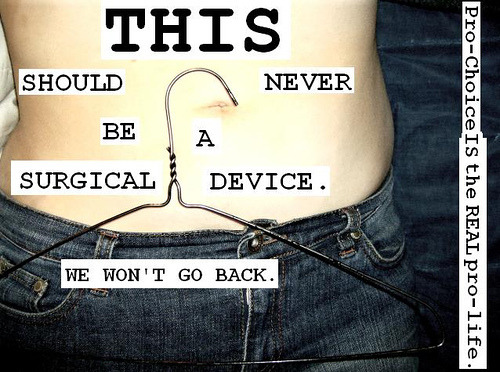
There are two further issues with 20 weeks - one being the anomaly scan carried out around this point in a pregnancy, and the other being the fact that some women end up waiting weeks to access the services they need when considering whether or not to have an abortion. It goes without saying that even when the procedure is restricted or made illegal, women will still find ways to do it. We don't demonstrate holding banners with pictures of coathangers for nothing.

To my mind, when I'm supporting a pro-choice point of view, I am "valuing life". Access to abortion should be combined with action on all the issues mentioned above - the sex education and the domestic abuse and the waiting times. It's not enough to talk about abstinence education yet send more families into poverty and cut funding to women's shelters. As @DillyTante said in an excellent post yesterday:

"Lowering the legal limits for abortion will not reduce the number of abortions. It will reduce the number of legal and safe abortions. Someone desperate enough to terminate a baby in the middle of pregnancy is likely to go to any lengths to do so. Reducing the legal limit for abortion will not result in more happy smiley chubby babies; it will increase the number of desperately unhappy women and children brought into this world in devastating circumstances. With a government reducing welfare and community support for families and people with disabilities this can only be a path to unhappiness for many."

As a Christian I'd like to see more of a "pro-life" commitment to this side of the story. Maybe then I'd be convinced that there is a real concern for women and their welfare. The desire to "value life" when "life" refers to a foetus is all well and good, but what of the lives and wellbeing of women? What of the life of the child once it's actually exited the womb? I don't see any of that in the demonstrations outside clinics, or in the desire to lower the legal limit on dubious medical grounds. And that's why I occupy my "niche" position: because I hope for something different. People are entitled to an anti-abortion view, but all too often they let themselves down.

50 Women to Watch: The Fallout

Saturday, 6 October 2012

I was slightly late to the party in seeing Denny Burk's response to Christianity Today's list of "50 Women To Watch", and the reactions it has caused.

Burk's main concern appears to be the fact that CT's list of "women to watch" contains no discussion about the controversy surrounding different perspectives on gender roles and therefore, highlights the work and careers of women excelling in areas that some complementarians don't believe it's their place to excell in.

"In general, it regards high-achieving women excelling in their respective fields as something to be celebrated," he writes, adding that he wouldn't have a problem with celebrating women if they actually, you know, knew their place and were "excelling in roles that the scripture commands".

"I wouldn’t celebrate those that I believe are serving in roles that scripture forbids," he explains in a comment.

Burk goes on to turn the comments section into a highly judgmental discussion on whether or not Rachel Held Evans (who is mentioned on the CT list) is really an evangelical, even after Evans herself comments to lay the debate to rest. That, however, isn't enough for him.

"I think you and I have really different views about what an evangelical is," he tells her, stating this again and again.

Comments on the post are numerous and come from both sides. When I first read the post, I felt pretty angry. It's just another example of the "interesting" stance on gender espoused by certain prominent bloggers and teachers in the USA, a stance that often begins with judgments such as those detailed above and leads to the characterizing of women who express disagreement as "shrill", "ranting", or "extreme". It's all part of the "interesting" stance that has left many people, men and women, disillusioned with church and with Christians, as well as giving the rest of us a bad name, and has even seeped into some UK-based discussions on gender recently. It's a stance that affects the way these prominent bloggers and teachers think about wider issues, such as rape. It's a stance that obsesses over tone policing and appearing "gracious" to the extent that nothing ever gets resolved thanks to an endless cycle of opinions, disagreement, tone arguments, posts about forgiveness and grace, then returning to square one until the next time it happens.

However it didn't make me angry for long. Moreover, it struck me as incredibly sad. Disappointingly sad, but also eye-rollingly, tediously sad. Firstly, the idea that the achievements of women should not be celebrated if they dare to work outside narrowly-defined roles. I mean, really. Secondly, the insistence of Burk on judging whether or not others are Christian enough according to his narrow standards - not uncommon, but arrogant all the same. Thirdly, the message that all this sends out - that prominent Christian "names" (if not in the UK, but among US evangelicals) actually spend their time being upset that other Christians are being praised, for no other reason than their gender. What does it say to people who are already increasingly disillusioned with what constitutes US evangelical culture (which if I go by what I've read in reports and on blogs in recent months, are numerous)? Nothing positive, that's for sure.

I think about what I've seen in the couple of weeks since all these lists started to appear, these lists of  "Top Bloggers" and "Most Popular" and "Ones to Watch". I think about the drama they've caused and the debates they've started. How time and time again they out themselves as a back-slapping exercise for high-profile white men, how they veer from being something to be proud of and display a button for to something that you wouldn't want to be a part of, oh no, because that would be thinking too highly of yourself and it's not your place and oh, you're just happy to blessed by the wonderful people who actually did make the list. Isn't it wearisome, and isn't online Christian culture stuck in a rut?

Someone I was talking to a couple of weeks ago on Twitter said the same thing - that they're sick of the circular debates and the way the discussions always go. It's time to change the way we go about these things, she said. Time to stop being nice and bending over backwards for people, whether they call us shrill or say we need to change the way we say things or straight out insult and patronise us.

See also:


Are women really "less ambitious" than men?

Friday, 5 October 2012


The results of an exclusive poll conducted for The Telegraph claim to show that women are less ambitious than men and that we're facing an "aspiration gap" between men and women in the business world.

The findings are the subject of a couple of stories published in the paper's newly-launched women's section called "Wonder Women", which is being billed as content that this generation of women will actually enjoy and identify with, rather than consisting of the usual "lipsticks, handbags or BMW - bitching, moaning and whining" (more on this later).

1,000 18-35 year olds were surveyed and it was found that just 16% of young women aspire to run their own business one day, and just 3% want to be the chief executive of a company - compared to 22% and 6% of men. It also looks like women aren't as concerned by earning a high salary, with 16% aspiring to take home £100,000 a year compared to 20% of men. 16% of those surveyed said they were happy to take home £30,000 a year, compared to 12% of men.

This, apparently, is indicative of the fact that women are less ambitious and less concerned with "climbing the corporate ladder" than their male contemporaries. But is this a bad thing? The article happily details the fact that a "surprising" percentage of both men and women have no desire to become a line manager or head of department - so is it a case of unambitious women, or both sexes being disillusioned with the traditional concept of "success"?

The idea that women are "less ambitious" than men is problematic from the outset, because it equates "ambition" with wanting to earn a high salary and become a chief executive. This leaves no room for the fact that there are many, many ways to be ambitious, and that money isn't the most important thing in plenty of people's lives. Andrew Hunter, co-founder of the company that conducted the survey, said he thought that young people "would have a little more aspiration than this". Surely it's not difficult to understand that the corporate world isn't everyone's thing?

More and more, it's being reported that people will take job satisfaction and a good work-life balance over pots of cash and an important-sounding job title any time. In my experience, the current economic climate coupled with 21st century workplace culture has made people reassess their priorities - and while everyone wants to make enough money, that's as far as it goes for a lot of people. We know that the job opportunities of years gone by aren't there any more, which is probably why so many of those surveyed were keen to work freelance or set up their own business.

It's also possible that people aren't interested in working their way up to management because they're unwilling to become part of a power structure they're not totally comfortable with. Leadership can be worked out in many other ways.

So is it cause for concern that women, in particular, don't seem so interested in that sort of life? No, not really. As someone who has plenty of ambition but has never aspired to corporate glory and a six figure salary, I can't see what all the fuss is about. It's suggested that we should be doing something about this supposed lack of drive in young women. By all means, we should be offering encouragement and resources if they need help realising such ambitions. But otherwise, I'm not so sure.

What the survey actually appears to suggest is that women are more interested in other career paths, and don't see business and cash as their route to "having it all", something I know is true for me and for many of my friends. It found that careers in the public sector and charity sector are the most desirable, followed by those in the IT and digital sector, and the media.

Speaking of which, you'd think that a so-called "sassy" new women's section would avoid going down the cliché-ridden route of stories about "Having It All". The same goes for illustrating said stories with stills from The Devil Wears Prada and pictures of Sarah Jessica Parker. It would be nice to see a move away from all that nonsense and towards a more up-to-date take on these issues, a take that doesn't see the woman who "has it all" as a woman with several children, a job in banking, the perfect relationship, and a house worthy of Elle Decoration. I'll be interested to see how Wonder Women pans out in the weeks to come.

One of the better points raised by The Telegraph's coverage is that childcare arrangements and attitudes towards mothers remain a major barrier to women achieving their career ambitions, and could explain the difference in aspiration between men and women. The cost of nurseries these days is the highest in Europe, which means it's not economically viable for many women to return to work, even if they're keen to do so. In my opinion that's worth addressing and something the government really needs to act upon, because it does affect the lives and careers of many, many women. Maybe then we'll see a change in the disparity between men's and women's ambitions.


This post originally appeared on BitchBuzz. Image via victor1558's Flickr.

Links round-up: Church x gender

Tuesday, 25 September 2012

I read this post over at Her.meneutics yesterday, entitled "Hookup culture is good for women, and other feminist myths". I have mixed feelings about Her.meneutics in general; I've read some great stuff on the blog and a lot of stuff that has't been so great. It's inevitable that many of the posts are filtered through the lens of evangelical culture in the US, and therefore sometimes really miss the mark on their interpretations of issues. Yesterday's post is a prime example, but also highlights the common misunderstanding that the goal of the feminist movement is for women to "become just like men", with all the problematic behaviours that this might entail.

Dianna Anderson tackles this in her latest blog, "Feminism is Not the Enemy".

"The sexual revolution of the 20th century, then, was not about “making women act like men.” Rather, it was about removing the double standard that surrounds sexual activity – the double standard we find replicated again and again in rules about sexual activity on private Christian campuses and on Sunday mornings from the pulpit."


Sarah Moon has written interesting post about what rape means to complementarians. In recent months she's been hard at work calling out a few prominent names on their attitudes, and the way their view of sex and purity sets up a negative and disbelieving attitude towards any woman who has been raped or sexually assaulted yet does not fit the "perfect victim" stereotype. She also addresses the fact that it's an opinion accepted by many that sexual violence occurs because women step outside their "God-given roles" and behaviours, meaning men are drawn to rape as a way of asserting the masculine authority they deserve. It sounds ridiculous, but it's a view I've seen argued on conservative blogs in the past.


Some complementarian evangelicals go beyond this to actually blame feminism for the very existence of rape. Douglas Wilson, for instance, believes that when feminists deny men the opportunity to practice “godly” authority over women, men react by taking back the authority that they deserve using violence.


“When we quarrel with the way the world is,” Wilson says, “we find that the world has ways of getting back at us.”


Adrian Warnock has published a post detailing what he sees as the "Complementarian-Egalitarian Spectrum". I was pleased to see that he'd made some changes to his initial post after an email from Rachel Held Evans, as I was slightly exasperated to see the "Strong Egalitarian" section make reference to adherents ignoring or devaluing scripture. It's good that there is now acknowledgement that there can be distortions on both sides. On the negative side, I don't recognise Adrian's description of an "Extreme Feminist" viewpoint. The idea that there's this goal of being "better" than men and a wish to emasculate them is a straw feminist stereotype. Surely for him, the more "extreme" end of the spectrum would mainly be comprised of separatists?


Running through all discussions, as usual, is the question of whether by "equal" we mean "the same", and how problematic this is for people who can't look past biology as a determining factor in, well, just about everything. I think it may have become my least favourite track for these debates to take as it always ends up with someone having to spell out to someone else that having different genitalia is not a barrier to equality because equality doesn't mean "physically identical", "having the same hobbies and interests", or "being able to create babies and breastfeed". Honestly, you'd think it wasn't straightforward.
 

Blog Design by Nudge Media Design | Powered by Blogger