Showing posts with label body image. Show all posts

An apology from OK! - why it was never just about Kate

Friday, 26 July 2013

OK! has apologised for its spectacularly misjudged cover that saw the magazine focusing on the Duchess of Cambridge's 'post-baby weight loss regime' in an edition that hit newsstands less than a day after she gave birth earlier this week.

The cover prompted a call to boycott the magazine by Katy Hill, and as outrage mounted, OK! attempted to avert what was clearly becoming a major PR disaster. The following statement was issued by the magazine's parent company Northern & Shell:

"Kate is one of the great beauties of our age and OK! readers love her. Like the rest of the world, we were very moved by her radiance as she and William introduced the Prince of Cambridge to the world. We would not dream of being critical of her appearance. If that was misunderstood on our cover it was not intended."

What the magazine has failed to understand is that everyone who saw that cover knows full well that the issue here is not about a perceived insult to Kate's appearance. You've got to be a pretty sad individual to take potshots at the looks of a woman who's just spent the best part of the last day in labour (and yes, screenshots of the musings of said sad individuals can be found on Twitter if you care to look), but that's not what OK! was doing. What was going on was, for women's magazines, the next logical step in the reader's "journey" through Kate's pregnancy and its connection to the way we're expected to control and scrutinise our own bodies.

Before she became pregnant, the focus was on her weight. As a woman who would obviously be looking to get pregnant in the near future, wasn't she a bit too thin? We saw headlines about "fears" for her fertility. As she was snapped with her stomach showing a slight bulge one day, it was speculated whether she was indeed pregnant or whether she'd just been pigging out on carbs. Did she look a bit rounder in the face or were we just imagining it? During her pregnancy, numerous stories about the size of her bump appeared. Was it "worryingly small"?

As Kate gave birth, the message to the reader was clear. How IS she planning to return to her pre-pregnancy shape? How can YOU emulate her? It's one of our priorities, as evidenced by the mileage women's magazines get out of celebrity baby weight stories every year. A focus on appearance, exercise and shedding weight at the time when what women need most is to rest, make sure they're getting enough food, and heal from the process of giving birth, is ridiculous, but it's not one that all women can ignore and brush off, as I hope Kate will be doing this week.

OK! magazine doesn't care that it's churning out this stuff - not to the extent of worrying about the impact on its readers. No doubt there's some concern that one of its biggest advertisers is reassessing its relationship with the magazine.No doubt there was also concern about another celebrity encouraging people to boycott the title. That's where priorities lie, and that's unsurprising, but depressing.

Possibly worse, however, than its cover, is a (now deleted) Tweet from the magazine, posted around the time that Kate left hospital.

One of the more bizarre things to come out of the birth of the Royal baby is the extent to which people - including newsreaders - seem unaware that when a woman gives birth, her abdomen doesn't ping back to its pre-pregnancy state immediately. Kate's being hailed as a heroine for busting the "last taboo" of pregnancy - simply for stepping out in public with a one-day postpartum stomach visible under her dress. They way women look as they walk out of maternity units across the land every day of the year is now, apparently, "being brave" and worthy of a pat on the head.

It's a sad thing that magazines are stooping to the level of the sort of people who take to Twitter to say "lol omg she still looks soooo fat". The fact that this particular magazine is one with a readership of 331,000 is possibly even sadder, because it shows that somewhere, somehow, people are buying into the sort of messages it gives out and the culture it's helped to create.

Genuine debate or manufactured media drama?

Thursday, 2 August 2012


They're the discussions that fuel debate on Woman's Hour, daytime television, and online. The hot topics of the moment - or sometimes a whole decade. But when does such a debate become less relevant to the lives of women and more like manufactured media controversy, doing nothing more than pitting us against each other and attempting to cause division? The answer is: usually after about five minutes - yet the discussion continues. Which so-called "debates" need to die a painful death for the good of all women?

The Size Zero Debate

Those three little words became a media sensation a few years back and people started to discuss the sizes of popular models, of 'worryingly thin' celebrities, and the existence of Size 0 clothing. Were they the cause of eating disorders in young women? What should be done about it? Week after week, magazines published the latest updates on the main celeb offenders, who seemed to hang out together, favour the same styles, and were often connected to Rachel Zoe. But what started out as concern over health and wellbeing soon became another stick to beat women with. Young women with eating disorders became stereotyped as silly girls trying to emulate sillier celebrities, thin women found themselves sneered at as "not what men want", and the appearance of women in the spotlight was picked over at every opportunity. In the meantime, nobody really cared about size 0 at all. Which leads us on to...

Real Women

They have curves, apparently. No man wants to have sex with someone who "looks like a 12 year old boy". But wait - "curvy" is so loaded that it can also be construed as a euphemism for "fat" and therefore might be offensive. How about magazines try to make us all feel better by interviewing men about what physical attributes they really want from women? That'll work. How about the nastier women journalists write columns sniping about thin women? In the end, it becomes apparent that what the media means when it talks about attractive curves is "larger than average breasts". And so the conclusion is reached. Real women look like Kelly Brook. Fast forward a few years and it's still happening (thanks to a rash of annoying Facebook groups and memes), but the papers talk about Christina Hendricks instead, and "curvy" means "size 10".

Having It All

This one rears its ugly head in the Daily Mail every couple of weeks as a way of berating women for daring to want children AND a job. But recently the "debate" has gone mainstream again, thanks to Anne-Marie Slaughter and a number of other well-known names weighing in on the supposedly failed dream. Thousands of women have collectively rolled their eyes and wondered why the way the media frames this issue doesn't actually apply to 90% of us, as if it's all about being the perfect mother as well as a banker or a politician. And of course anti-feminists and conservatives seize the opportunity to crow about how unhappy and unfulfilled these liberal times have made women feel. Meanwhile, most of us continue going out to work because we don't have any choice in the matter.

Feminism: compatible with makeup, shaving, and liking men?

In recent years, a popular feature idea to wheel out for International Women's Day, usually disguised as a missive about the state of modern feminism and illustrated with a picture of a burning bra. So repetitive is the format that you wonder what readers are left thinking about the fight for gender equality, and also what harm it would really do to discuss it in terms of things that aren't lipstick and sex. Patronising, short-sighted, and cliched, reducing gender equality to a list of things you can and can't do, and never failing to leave some people with the impression that feminists hate women who wear dresses and like baking, which in itself has become another tedious "debate".

Mommy wars

Currently taking the form of drama over how long it's appropriate to breastfeed for. Such has the animosity over which childbirth and parenting choices a woman makes increased that a mere mention of the way you do things is enough to make some people feel you're judging them for not doing the same. Some of the most weirdly drama-filled and vicious debates I've seen between women online have been about birth and parenting choices, and guilt-tripping or sensationalist news stories don't help matters, constantly painting some choices as bizarre and abnormal, some as neglectful, and others as "the latest trend". Motherhood is enough of a minefield of emotions without all this, thanks very much.

Miss Representation tells it like it is

Friday, 28 October 2011

A new film exposes the way representations of women in the media lead to under-representation of women in positions of power. And it's long overdue.

"You can't be what you can't see". The words jump out at us from the screen in the trailer for Miss Representation, a new film exposing and challenging the media's portrayals of women and girls, which is causing a stir in the US since its broadcast premiere last week.

Written and directed by Jennifer Siebel Newsom, the film interviews teenage girls as well as famous faces like Condoleezza Rice, Nancy Pelosi, Rosario Dawson and Gloria Steinem in a quest to show the public just what's so wrong about the way the US media treats women and girls and what sort of effect it's having on their lives. Its findings are depressing, showing that while women continue to be seriously under-represented in politics, business and journalism, they're continuously judged on their looks, age and weight. Its aim is to get people thinking about just what is so wrong with all this.

"I'm hoping that we can start the discussion, and actually the discussion turns into action around valuing women in our culture. And that's huge," said Siebel Newsom in a recent interview.


Even if you haven't watched the trailer yet, with its footage of bikini-clad women in music videos interspersed with derogatory newspaper headlines about women politicians, you can probably reel off a list of the ways the media and popular culture makes it abundantly clear what us women are good for. We're the eye candy, the gender whose worth is bound up in how "sexy" we are. We're the bitches and the backstabbers and the lovers of "catfights". The "yummy mummies" and the "slummy mummies". The bosses from hell and the boardroom "ballbusters". When we go into politics, the newspapers run stories on our dress sense and cleavage rather than our achievements. Men turn up at our public appearances holding banners saying "Iron my shirt".

How is this making the women of the future feel and what's it doing to their ambitions? Miss Representation reveals all. It reveals how such toxic imagery is making girls and women feel devalued and ignored - as one teenager says, it's as if no-one cares about their brains, only their looks. It reveals how girls' dreams and ambitions change over time, as they find themselves trapped in stereotypes of what a woman should be and treated accordingly by boys, trapped by the perception that "feminine" or "like a girl" means "inferior".

It feels as if a film like this is long overdue. We've seen the reports on the value of really including women and raising them up to their full potential. The positive impact when they participate fully in the workplace, in the making of laws and the running of nations. And yet in countries like the US and the UK - countries seen as leading the way in other areas - women are being let down badly.

The way we're guaranteed to get media attention is by taking our clothes off. Of course the reception will only then be positive if we adhere to certain beauty standards, otherwise our "imperfections" will be raked over. Keeping our clothes on doesn't make us immune either - we're encouraged to judge and snipe from the off at unflattering cuts, visible body hair and unsightly bulges.

I hope the film will really make people think and start productive discussion about how we can combat these messages about women. All too often I think they're accepted as a fact of life. Even when people aren't happy about it there's a shrug of the shoulders and a roll of the eyes: that's just how the media is, right? Wrong. Something has to be done - and thankfully, Miss Representation isn't just a film: it's also a campaign.

By signing up through the organisation's website, you can become a Social Action Representative, download materials for use in schools and universities (US/Canada only) and access a conversation guide to help you bring up the issues the film raises with your family and friends.

I for one am excited about the impact all this is going to have as more people watch the film and are moved by its message. If taking action would mean more girls reaching their full potential and not being afraid to show who they really are, would you do it? By refusing to buy into and take notice of the stereotypes that bring us down and patronize us every single day, I think it's possible to effect change.

Check out Miss Representation on Facebook and Twitter for more news.

This post originally appeared on BitchBuzz. Photo via guelphguy's Flickr

Stripping off in the fight against discrimination

Wednesday, 21 September 2011

If a group of women pose naked to "fight" ageism and sexism, how much does it achieve?

The problem with ageism on television is that it's also one of those issues that disproportionately affects women. Women who find themselves sidelined and taken off camera once they're a little more "mature". Women who are told they might want to try wearing more makeup to minimize their wrinkles, lose a few pounds and get a more "youthful" haircut.

At the same time, male presenters of advanced years continue to grace our screens, often accompanied by a much younger female presenter (see the pairing of Bruce Forsyth and Tess Daly on the BBC's Strictly Come Dancing for a start). Older men on television are "distinguished". Older women are "past it" and caricatured as hags.

The problem of women being sidelined as they reach middle age has, in the past few years, reached the stage where one television presenter, Miriam O'Reilly, has won an employment tribunal against the BBC on the grounds of ageism, and it has been reported that the BBC has settled out of court with 12 other women presenters.

In 2010 former newsreader Selina Scott spoke out in the press about the problem of sexism and ageism on television. This year, a group of presenters and actors are going one better in their quest to prove that middle-aged women have a place on screen.

In a magazine interview and photoshoot this week, Loose Women presenters Sherrie Hewson and Andrea McLean, along with actors Beverley Callard and Gillian Taylforth - who range in age from 41 to 61 - discuss ageism on television. In the feature for Best magazine's "body image issue", they talk about feeling passed over for roles because producers think they're too old and because few storylines are written about women their age.

"In TV, it's OK for men to be 50 or 60, but for women it's very difficult. Older actresses can feel put by the wayside," says Taylforth.

The best, however, is yet to come. In the photos accompanying the story, the four women are seen posing naked. Tastefully naked, I might add, covering up breasts and with strategically placed legs. The point, of course, is to show that while they may be middle-aged, they've still "got it". That producers may sneer at their wrinkles, but they're embracing the way they look because it's a natural part of getting older.

There's just one thing. Isn't it telling that you'd never expect to see a group of male actors and presenters "stripping off" in a bid to prove they're still worthy of airtime? Can you imagine George Alagiah or Terry Wogan getting naked, revealing what clothes size they take and the secrets of their exercise regimes (as the four women do) while discussing ageism on television? You can't, because it would be ridiculous.

It's only ever women who end up having to do the whole "Look! I've still got it!" routine for the media. Men never have to go through the whole charade - why would they? Women having to prove themselves shouldn't be our reaction to the problem of discrimination. It should be seen as part of the problem.

It's pretty sad, to be honest, that the first thing that comes to find when the media wants to focus on a major issue of sexism and ageism involves targets of said sexism and ageism stripping off to "prove" themselves worthy contenders in the "fight" against such discrimination. It's similar to when the newspapers profile groups of businesswomen and insist on "sexy" photoshoots, or when they run features on sportswomen and show them in lad's mag-inspired poses, talking about their love lives (of course!).

On one hand they're trailblazers and role models, on the other it's still part of their job to be hot when required, lest they run the risk of becoming one of those women in the public eye who's derided for having a "mannish" haircut or wearing unflattering jackets.

I do think there's a lot to be said for attempting to promote satisfaction and body confidence among women of all ages and so I can see why Best chose to run the feature. It's good that it's getting more coverage outside the usual news stories of women in television suing their employers. Plenty of people are probably going to see it as a light-hearted bit of fun - so Calendar Girls!

But what I'd really like to see is the problem tackled in a more imaginative and truly positive way. There's so much work to be done and I wonder how much of an impact women "stripping off" can have outside of providing tabloid fodder and further ingraining the difference between the way men and women in television are expected to look and act.

Let's not fight ageism and sexism with more sexism, albeit sexism that's wrapped up in a chummy, encouraging, Gok Wan-esque package.

 This post originally appeared on BitchBuzz. "Home made Botox" photo via Emanuela Franchini's Flickr.

"Thinspiration", as seen by the Daily Mail

Thursday, 8 September 2011

Hey, Daily Mail!

I don't believe I've done this for a while, possibly because there's only so many times we can criticise abominations like the Sidebar of Judgment and the Mail's hypocrisy relating to the sorts of pictures and stories they feature there, but I felt I should point something out following Lorraine Candy's most recent column, published yesterday.

In this column, Candy talks about being amazed at the self-discipline and willpower Victoria Beckham must have to be appearing in public looking "back to normal" so soon after the birth of her fourth child. And so as one might expect, the Mail decided to illustrate this point of a picture of Beckham with baby Harper.

What I find particularly inappropriate, particularly "squicky", about this is the picture caption, which reads "Thinspiration: Victoria Beckham".
 
Let's get this straight: "thinspiration" isn't some casual descriptor you can insert into picture captions on the website of a national newspaper. It's a term that has long been used by pro-eating disorder websites and sufferers, as described in the Wikipedia entry for "Pro-Ana" (warning: triggers abound in the form of photos).

It has very particular connotations, none of which make it acceptable to use in a column about post-pregnancy weight loss. Given that the Mail has enjoyed, over the years, expressing outrage at the harmful influence of thin celebrities, Kate Moss's quote "Nothing tastes as good as thin feels" and "the size zero trend", you'd think it would be clued up on appropriate usage of the word "thinspiration".

Let's not see this become a regular occurrence.

The 'sexualisation of our daughters' and double standards

Wednesday, 20 April 2011

Last night I decided to watch The Sex Education Show in the hope that it might provide some food for thought of a bit more substance than the recent edition of Panorama, entitled 'Too Much Too Young' focusing on the moral panic over 'girls growing up too fast', 'sexualisation' (which now seems to be the accepted shorthand for the whole phenomenon) and high street stores selling 'inappropriate' clothing.

Coverage of this issue on television and in the media has been problematic for a number of reasons. Take the comments of the mother on the Panorama documentary, who was concerned that her daughter wearing short skirts and 'showing her legs' would lead to an underage pregnancy. Or the tabloid headlines which labelled Primark's padded swimwear for seven-year-olds as the 'PAEDO BIKINI'. The fact that the outrage exclusively focuses on girls, the way they might behave or the things that might happen to them as a result of liking or wearing certain clothes or being exposed to sexual imagery, rather than addressing the issues in the ways they affect boys, looking at the wider problems surrounding the way we view sex and relationships as a society, or asking the girls themselves what they actually think about it all. The way it practically demonizes sexuality at an age where children are probably going to be having a lot of questions about it and getting a lot of messages from society which are pretty confusing to them.

As I'd expected, The Sex Education Show went down the usual track of hand-wringing about miniature heels and bras, then filming 'stunts' which involved entering and protesting at 'guilty' stores such as Primark and Matalan, something which was particularly unproductive.

What struck me, perhaps over anything else, was the huge double standard which exists in all this media coverage and all these documentaries. People are horrified that young girls might be 'pressurized' into wearing heels or makeup or padded bras or showing themselves to be sexually 'available' and 'raunchy', despite the fact they're only seven, or 10, or 12. It's taking away their innocence, leading them down the wrong path, making them focus on the wrong things. Many people interviewed about it all have said that they want their daughters to be interested in a diverse range of pursuits, like sport or science or music. This is all great.

But the moment these girls pass the point where they're no longer considered 'children' any more, everything changes. As women, they'll no longer be expected to shun padded bras and makeup and an obsession with being attractive as 'inappropriate'. It will be become a requirement. If they have small breasts they'll constantly receive messages from shops and the media that they need to look more 'curvy', 'create the illusion of cleavage' and possibly have surgery to get the perfect figure. If they show up at the office without makeup on or in flat shoes, they might be asked to do something about it. Women's magazines will tell them how they should modify their behaviour in order to attract - and 'keep' a man. There's still the ridiculous stereotype, in some quarters, that men don't like 'brainy' women.

In short, if the 'too much too young' culture is going to change, this change needs to happen from the top down.

Young girls seek to emulate famous women, their mothers, their older sisters. If they see that these women's lives are controlled to a massive extent by diets, looking conventionally attractive and personal grooming, what choice is there for them? They are learning from a very young age that our society teaches women they must live up to certain standards in order to gain approval and be a 'real woman'. Who is helping them to see through this? If they hear their clothes being blamed for negative attention or harassment they might receive from the opposite sex, where does this leave their self-esteem in the face of victim-blaming? If they're told that sexual activity and curiosity at a young age is bad, but don't receive comprehensive, careful and thoughtful education and advice about it from their schools, friends or parents, they'll only end up confused further, especially when the moral panic is exclusively targeted at one gender.

I'm sure that we're going to continue seeing a great deal about the problem of 'sexualisation' in the news and on television. What this coverage needs is a more rounded and balanced perspective on the issues involved - and acknowledgement that they will not go away unless we stop expecting grown women to live this way while condemning girls for doing the same things.

Guest Post: Hey! Tabloids! Leave Those Kids Alone!

Monday, 21 March 2011

I’d like you to come with me for a moment and enter stage left on every Scout leader’s most disliked experience. It’s raining, your scouts are trying to strike camp. And somebody somewhere is having some kind of “issue”. Odds are a couple of the lads have had a “full and frank exchange of views” and are right now squaring up to each other. Or else somebody has dropped something heavy on a painful part of their body. Kids are great at picking their moments.

“What’s up?” I trot over to the site of the commotion.

“It’s R,” someone says. “She’s not well”.

R is slumped on the floor looking, for want of a better word, like death warmed up. Her worried looking patrol leader (a senior 13/14 year old scout for the uninitiated) and a couple of her friends are stood next to her. R looks pale and is pretty tearful. I deal with it, the gathering crowd are shooed away and I find out the story. In short she’s knackered. She’s knackered because she’s been on the go for the last 3 hours, but unlike the rest of them quietly went without breakfast (and that is to my discredit for not noticing). A mug of hot chocolate and a slab of kendal mint cake later and she is back up and running with her blood sugar back to where it should be. Spot of first aid on camp, not a big issue you might say.

Actually it is a big issue because R is 12 years old and scared of getting fat. And she’s not alone.

As it happens the above is fiction, it would not be appropriate to recount events about a real child, yet it isn't a total lie. It's based on several similar incidents that both I and fellow Scout and Guide leader friends have dealt with. Luckily I have never had to deal with any child with a full on eating disorder, although I know others that have. Yet from what I have seen I don't think it will be long before I do. It may end up being a boy (pressure on boys to be perfect is growing but that is another story for another day) but most likely it will be a girl.

How has it got to the point that I, a 32 year old man, am scraping 12 years girls up off the floor because they are not eating enough? I don’t think that there is a simple answer to that, the reasons are pretty complex, but one of those reasons is, I am convinced, the media obsession with female celebrities and what they look like.

Shortly before Christmas the Daily Mail published this article about Megan Fox. It seems she had the audacity to lose some weight and was a bit thin for the liking of the Mail. It wasn’t that long ago that another celeb was too fat for the Mail (complete with oh-so-subtle comment about curry and pint deal at her local). It doesn’t even have to be the fat/thin thing to get the tabloids (or indeed sometimes the broadsheets) going. It includes almost constant stories about how any woman in the public eye looks, how they dress, what surgery they’ve had, what they’ve done with their hair, ad nauseum, ad infinitum. It seems that what women look like has become the only topic in town.

At the time of writing, on the front page of the Mail website there are no less than 27 stories about what various women celebrities look like, and 3 about men (plus one about Romeo Beckham - don’t think he counts as a man just yet does he?).

And it is not just the tabloids, it’s women’s magazines, men’s magazines, TV shows, broad sheets, websites, you name the media source and it’s there (with the possible exception of radio). It seems like there is a never ending drip feed of the same message, “you have to look perfect, you have to look perfect, you have to look perfect”. And that drip feed hits home every where, from mature adults through teenagers and now to frighteningly young kids.

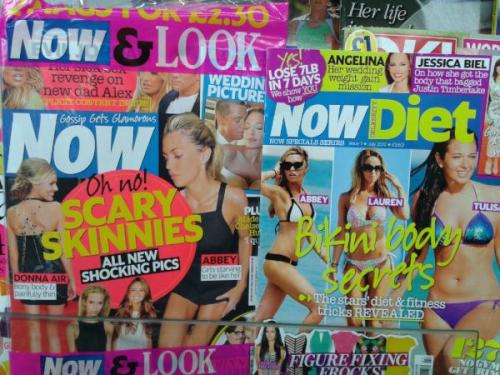
The result of that does not always result in kids keeling over from lack of food. It manifests itself in a number of other ways. It’s the girl that won’t go canoeing because the wet suit makes her look fat, or won’t use sunscreen because she has to have the perfect tan. And on each occasion you wonder where such a young girl is getting the impression that she has to look perfect, that it really would be a disaster to look anything other than perfect. And time again I come back to the media. Looking at the fronts of magazines in WH Smith, every one of the women’s magazines seems to be obsessed with the latest diet and the shape of whoever is the celeb of the moment. Doesn’t X look amazing for losing weight? Isn’t Y struggling to fight the pounds? And so on and so forth.

Of course the attitude of some boys doesn’t help either (and yes, in Scouts we do crack down on it), yet even some of the attitudes of teenage boys, treating girls simply as sexual objects which is appearing at an increasingly early age can be traced to the media and in particular the grossly irresponsible "lads' mags".

There are of course women who use their body image to make money, as is their right, but we are not talking here about the portrayal of professional models or those who deliberately court attention. It is those constant stories where celebs are snapped while on holiday or out shopping or in the park with their kids, the constant media intrusion that worries me. Those stories show that yes, the glamorous actress does sometimes walk to the corner shop for a pint of milk wearing a hoodie and no makeup, just like we all do. Yet rather than any hint that this is totally normal behaviour girls are told that this is weird, you can’t possibly do that! And so impressionable young girls get the impression that they have to look perfect (whatever that means) all the time and start to worry when they don’t.

I don’t write this pretending to have any answers, I don’t really know where you begin trying to change the whole sorry mess (although on a personal level I hope that organisations like scouts and guides provide an environment where kids can learn that there is far more to their self worth than what they look like). I don’t know what you try and change first or how. But until something does change I guess I’ll just carry on scraping 12 year old girls up off the floor.

This is a guest post by Akela. He's a left wing, enviromentalist, Christian, cheese-eating, football-following, real ale-drinking Scout Leader with a serious dislike of the tabloids. A wannabe children's writer, he used to blog regularly but now just surfaces on other people's blogs instead.

The Daily Mail and the Sidebar of Judgement

Thursday, 17 March 2011


Last week Penny Smith, writing for the Daily Mail, asked 'Why do we women hate our bodies?'. Several of my fellow tabloid-watching bloggers pointed out the hypocrisy of the Mail's obsession with asking this question (look back through the archives and you'll find several similar stories published over the past couple of years). I must admit I haven't been visiting Mail Online much recently. It's probably been good for my sanity. But following Smith's piece going up, I've been interested to see how the site does absolutely nothing to help the way women might be feeling about their bodies.

The famed Mail Online sidebar has always been the Sidebar of Judgement, the place to go if you want to laugh at women in 'unflattering' dresses or disapprove of average-sized people daring to wear bikinis while pursing your lips at Suri Cruise's lost childhood and Kerry Katona's Ultimate Bad Mother status.

But as the paper publishes columns lamenting poor body image among modern women, the Sidebar of Judgement, dare I say it, appears to be getting worse. There's no longer any variety in the women's interest-flavoured stories it features. It's a relentless rotation of judgemental pieces about cellulite, stomach flab and weight loss. Top story today features 'real women' creating Kate Moss's look in order to show that they have better backsides than she does. Give me strength. But there's more:

- 'I work out seven days a week... but I still have jiggly thighs and cellulite,' admits Kim Kardashian
- So that's why Cher Lloyd looks the picture of health - she lives on greasy portions of chips
- Teen Mom 2 star Jenelle Evans makes for an arresting sight (in a bikini... not at court, that is)
- What a knockout: Sucker Punch star Abbie Cornish does scantily-clad sultry shoot for GQ magazine
- What happened to Nicole's legs? Scherzinger goes for the wrinkly look in mismatched boots and dress

Yesterday the Women's Networking Hub tweeted:

Has disordered eating for women and girls become the norm, as entrenched behaviour patterns are now granted as acceptable?

This is a good question. The phenomenon is certainly being fuelled in part by the attitudes of media aimed at women, with the way it constantly judges the body, insinuates that our bodies, as they are naturally, are unaccpetable and encourages unhealthy and drastic diets as a means of achieving confidence and acceptance. As a result we categorize all food as either 'good' or 'bad'. We justify eating a chocolate bar by saying that it's okay, we'll go to the gym later, or we'll only have a small dinner. We gravitate immediately towards the 'low fat' or 'light' sections when we go to buy a sandwich for lunch whether we're overweight or not. We discuss it and we treat all this as totally normal, totally ordinary attitudes towards eating and sustaining our bodies.

There's a familiar series of events involving celebrity women and the media. Step One: the woman, who does not adhere strictly to the accepted 'thin but curvy' body type, is picked over and ridiculed by the papers, magazines or blogs. Step Two: she loses weight and said papers and magazines run triumphant features on her new found confidence and happiness. She'll be wearing a bikini or a corset and grinning. Step Three: she'll put a bit of weight back on. Step Four: she'll appear in one of these papers and magazines solemnly discussing how that weight loss was unhealthy for her, how she exercised far too much, how she made herself sick or took diet pills or barely ate. And people will shake their heads and tut about the negative influence of the media.

All this will be chronicled in the Sidebar of Judgement.

Links while I recover

Saturday, 12 March 2011


I'm back in the UK and slowly starting to feel less wiped out after an amazing and life-changing week in Brazil (including a great IWD). So while I recover, here's what I've been reading this week:

And watching:


Courtesy of the EQUALS coalition.

Just As Beautiful - now available in print

Thursday, 30 September 2010


The UK's first magazine solely aimed at and featuring plus-size women has made the transition from online to print, generating a lot of discussion in the process.

Just As Beautiful magazine, which has been available to subscribers in online format for three years, can now be purchased via its website. When i tweeted the news this morning my words were met with several irritated reactions from friends and followers - people who sit in the 'plus size' category themselves yet feel that a magazine that singles them out is patronising and offensive to women whatever their size. People who aren't plus size and felt the language used by the magazine is negative and defeats the object of being more inclusive.

I took a look at the press release about the magazine's launch and I have to say, it rubbed me up the wrong way immediately. Reference to Christina Hendricks? Check. References to 'size zero' and 'impossibly skinny' models? Check. Footnote declaring that 'Men prefer women with curves'? Oh yes.

There's some good points in there - the fallacy of the diet industry, the editor's statement that she wants readers to feel they shouldn't have to change the way they look to be happy. But really, did it have to packaged alongside all that 'size zero debate' (come on, it's not 2006), 'what men really want' rubbish?

Whenever I talk to women about magazines they usually make two main points. Firstly, how much they'd love to read publications which feature a wide variety of women and secondly how much they'd love to read publications which didn't insist on telling us 'what men REALLY want' every issue. In an ideal world this would work out fine. I'd love to see magazines which really support women and don't rely on pitting us against each other by making snide comments about what's supposedly attractive and what's not. It's such a tabloid tactic - women vs women, good for a bitchy feature.

Many mainstream women's magazines are guilty of fatphobia. I don't this means that publications seeking to be inclusive and raise self esteem should go the other way and start promoting themselves alongside quotes about the desirability of 'curves' and comments about the bodies of models - who incidentally, are 'real women' too, no matter how thin they are. And while plus size women may shop at different places to those usually featured in mainstream magazines, what's with all the rest of the content especially aimed at the larger woman? I couldn't help feeling that this setting apart has got undertones of those times when major fashion magazines produce one issue featuring curvier or older models, yet refuse to feature them at any other time of the year.

I started a discussion about Just As Beautiful at a community I'm part of, laying out my thoughts and feelings about the way the launch has come across first. The general consensus was that while the magazine's aim is probably in the right place, it's not something any of the women who commented on the post would want to buy. The magazine's title was a major sticking point. You can't deny that it's a fine example of an almost unbearably patronising title. When I was growing up there was a plus size shop in my town named 'Pretty Big' and to be honest Just As Beautiful has that same level of cringe about it.

Some noteworthy comments:
"There is a major issue of fatphobia in women's magazines but by publishing this, they're shooting everyone in the foot. Specialist magazine showcasing plus size women and issues = no longer concern of regular magazine because there's a magazine doing all that. What little exposure plus size women/issues get in other women's magazines might go *poof* in light of this..."
"Just because my body is a particular size or shape, it doesn't mean that i'm going to automatically need to read all about it, you know? I'm not just a body, grasping for anything that vaguely might resemble me. And if it had some intelligent articles about women's bodies, the problems facing all sizes in the media - it'd be different. But this just seems reductive and patronising."
"I've always felt that even though I'm a size 16/18, I have exactly the same lifestyle, goals, interests as a size 6/8 woman. It means that a fat woman's lifestyle is dictated by her fat, and suggests that they need to approach life in a different way from a slimmer woman, which is perverse. Although I 'fit in' with this magazine's target audience, the fact I still live my life as I would whether I was bigger or smaller means that it's entirely redundant to me. I dress how I want to dress, I socialise how I want to socialise, I have attractive partners to whom I'm genuinely attracted...I'm strong academically, I have distinct ambitions. And none of that has anything to do with my size."
"...it makes me feel really uncomfortable when plus-sized women...are labelled as 'real' women - thin women aren't imaginary! It's another way of saying that attractiveness in a woman is defined by whether or not men find her attractive. Aside from the inherent heteronormativity in that way of thinking, it's just plain misogynistic."
Overall there was a feeling that trying to keep two groups of women separate purely because of size is a negative thing and that magazines should be trying harder to be inclusive of everyone.

Obviously there's the other side of the coin to consider. According to its editor, the magazine has achieved great popularity over the last three years and has proved a great find for women who feel excluded by mainstream mags. You can't disagree that many of these magazines display an extremely dismissive attitude towards women who aren't thin, most obviously when it comes to features about clothes. As I mentioned above, there's the one-off issues 'celebrating' women who aren't young, white and thin but sadly that's all they are: one-offs.

These magazines do need to do better. Stop sending your size ten writers off to get Harley Street treatments for 'that stubborn tummy roll' or 'those nightmare saddlebags'. Stop pretending that crash diets are normal. Start taking a more inclusive approach to fashion. Maybe then women bigger than size 12 won't feel like they need a separate magazine to cater to their interests and lifestyles.

There is a problem with self esteem linked to women's magazines and by being critical of Just As Beautiful I'm in no way criticising its readership or its original aims. But it's certainly something which has got a lot of people talking and many things about it have made me uncomfortable.

Kate Bosworth's 'mini meals'

Saturday, 5 June 2010

This time four years ago I was working as a journalist, writing features which I'd usually pitch to women's weeklies. This involved a great deal of looking at said women's weeklies. All of them. I was not the person I am today - in fact I was a big fan of Grazia magazine and the way it blended current events-related stories with decent fashion pages. Back then the magazine hadn't been around for too long and there was such a buzz around it.

I don't buy Grazia any more because although I do still like its fashion pages, I can only look at so many pages on anti-ageing treatments, cosmetic surgery and selfish first world problems before I want to smash things. And don't we all get sick of magazines in general during the summer months, with their back to back features on swimwear, tanning and 'getting the perfect beach body'?

I happened to be in town this afternoon, however - and found myself browsing magazines. Just for a change, Grazia had a picture of Jennifer Aniston on the cover, apparently as part of a feature on how celebrities get in shape for the summer. I had time to kill and decided to have a quick flick through the magazine: first stop the fashion section. Swimwear. And so I eventually ended up looking at this piece on how Jen and all the rest of them get their 'bikini bodies'.

Business as usual - lean protein, squats, leafy greens, exercise balls. Nothing that you haven't read a hundred times before. And then the paragraph about Kate Bosworth caught my eye. It read something like (I'm remembering this as accurately as I can):

"Kate's a fan of mini meals. She eats what she wants but stops after three bites if it's fattening."

Oh and she does an hour of cardio six times a week and an hour of weights five times a week, apparently. It's good to know. For a moment I'm going to return to that bit about 'mini meals' though. Is this for real?! Lean protein and squats I can can deal with. Those 'diet plans' that plenty of other magazines feature every week where you get to eat small and very healthy but essentially nice-tasting meals? I'm not down with the sort of culture and obsessions they promote but at least, you know, you get to eat a whole meal. So does Kate only order three bites' worth of food? Does she throw away the rest? Did Grazia just make this crap up because it sounded like something a celebrity would do?

Actually I don't care that much. It makes me more angry that magazines continue to promote obsessive and unhealthy relationships with food as something we should consider if we want a 'better' body. They told us exactly how to go about the 'baby food diet' - yep, you really do get to eat baby food. Straight out of those little jars. Then there was the one where you eat nothing but some vile mixture of maple syrup and cayenne pepper. But only eating three bites of stuff if it contains certain things? That sounds like unhelpful behaviour to me.

I know that it was being used as an example of how a famous person 'stays thin' and that readers are supposed to see it all as faintly ridiculous. I know it wasn't saying 'you should totes do the mini-meals diet this summer!'. But seriously, is this the relationship with our bodies that we're supposed to aspire to? They can as many features on the terrible consequences of eating disorders and as many pieces on 'loving yourself as you are' as they want. At the end of the day though, Kate Bosworth's only ever eating three bites of something and she's got a fabulous body, which is what matters.
 

Blog Design by Nudge Media Design | Powered by Blogger