Towards a more wide-ranging "pro-life"

Sunday, 7 October 2012


"Being a pro-choice evangelical is a bit niche, isn't it?" I said to someone in the midst of the latest blowup over abortion rights. First it was Maria Miller and 20 weeks. Now Jeremy Hunt and his support for a 12 week upper limit, which has had all my fellow pitchfork-wielding leftie Twittermobbers raging for the past couple of days.

Hunt stated in an interview that his view on the 12 week limit is down to his personal belief "about the moment we should deem life to start", not, he added, "for religious reasons". David Cameron has responded by saying that the government "has no plans to bring forward any legislation in this area". Still, it's unsettling, isn't it? Both the minister for women and the health secretary. Whether Cameron's got plans to that effect or not, it's got people worried yet again, that little by little we're going to see that limit chipped away.

Being pro-choice means that people ask me things like why, as a Christian, I'm not "valuing life above all else". If babies born before 24 weeks have survived, why shouldn't the cut-off point be 20 weeks? Meanwhile, people talk about those who want a 20 week limit as "hating women". Both sides of the debate, at their extremes fuelled by comments like Hunt's, are completely unhelpful.

My issue is this: on the side of the debate that values life above all else, there is plenty of commitment to slashing the legal limit for women to have abortions (based on the survival of a handful of babies), but precious little noise made about addressing many of the issues surrounding why women are having abortions in the first place. Take, for example, these case studies from BPAS showing the reasons for requests for abortion over 22 weeks gestation in 2008. Poverty, abuse, homelessness, addiction, mental health issues, stalling on the part of the NHS meaning women had had to wait weeks to access services. And several women who had no reason to believe they were pregnant in the first place.

It's my belief that a commitment to lowering the number of abortions should go hand in hand with a commitment to lowering the number of unwanted pregnancies and supporting women at all stages of their lives. Unfortunately you don't often hear those who are anti-abortion talking about better sex and relationships education for young people, easier access to contraception, addressing issues such as domestic violence, poverty, rape, and support for women who are unsure about what choice to make that doesn't just involve telling them how much they'll regret having an abortion. More talk like that might mean more people would believe Maria Miller when she calls herself a "very modern feminist". We haven't quite reached the same state of affairs as the USA yet, but who knows what could happen - as Tanya Gold said in a piece for The Guardian on Friday:

"The abortion wars in America, funded by Republicans who want miracle babies but not a functioning welfare state..."

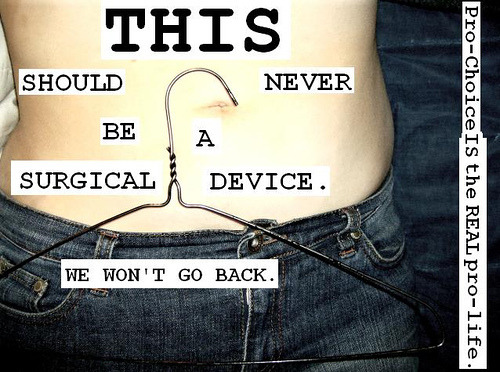
There are two further issues with 20 weeks - one being the anomaly scan carried out around this point in a pregnancy, and the other being the fact that some women end up waiting weeks to access the services they need when considering whether or not to have an abortion. It goes without saying that even when the procedure is restricted or made illegal, women will still find ways to do it. We don't demonstrate holding banners with pictures of coathangers for nothing.

To my mind, when I'm supporting a pro-choice point of view, I am "valuing life". Access to abortion should be combined with action on all the issues mentioned above - the sex education and the domestic abuse and the waiting times. It's not enough to talk about abstinence education yet send more families into poverty and cut funding to women's shelters. As @DillyTante said in an excellent post yesterday:

"Lowering the legal limits for abortion will not reduce the number of abortions. It will reduce the number of legal and safe abortions. Someone desperate enough to terminate a baby in the middle of pregnancy is likely to go to any lengths to do so. Reducing the legal limit for abortion will not result in more happy smiley chubby babies; it will increase the number of desperately unhappy women and children brought into this world in devastating circumstances. With a government reducing welfare and community support for families and people with disabilities this can only be a path to unhappiness for many."

As a Christian I'd like to see more of a "pro-life" commitment to this side of the story. Maybe then I'd be convinced that there is a real concern for women and their welfare. The desire to "value life" when "life" refers to a foetus is all well and good, but what of the lives and wellbeing of women? What of the life of the child once it's actually exited the womb? I don't see any of that in the demonstrations outside clinics, or in the desire to lower the legal limit on dubious medical grounds. And that's why I occupy my "niche" position: because I hope for something different. People are entitled to an anti-abortion view, but all too often they let themselves down.

50 Women to Watch: The Fallout

Saturday, 6 October 2012

I was slightly late to the party in seeing Denny Burk's response to Christianity Today's list of "50 Women To Watch", and the reactions it has caused.

Burk's main concern appears to be the fact that CT's list of "women to watch" contains no discussion about the controversy surrounding different perspectives on gender roles and therefore, highlights the work and careers of women excelling in areas that some complementarians don't believe it's their place to excell in.

"In general, it regards high-achieving women excelling in their respective fields as something to be celebrated," he writes, adding that he wouldn't have a problem with celebrating women if they actually, you know, knew their place and were "excelling in roles that the scripture commands".

"I wouldn’t celebrate those that I believe are serving in roles that scripture forbids," he explains in a comment.

Burk goes on to turn the comments section into a highly judgmental discussion on whether or not Rachel Held Evans (who is mentioned on the CT list) is really an evangelical, even after Evans herself comments to lay the debate to rest. That, however, isn't enough for him.

"I think you and I have really different views about what an evangelical is," he tells her, stating this again and again.

Comments on the post are numerous and come from both sides. When I first read the post, I felt pretty angry. It's just another example of the "interesting" stance on gender espoused by certain prominent bloggers and teachers in the USA, a stance that often begins with judgments such as those detailed above and leads to the characterizing of women who express disagreement as "shrill", "ranting", or "extreme". It's all part of the "interesting" stance that has left many people, men and women, disillusioned with church and with Christians, as well as giving the rest of us a bad name, and has even seeped into some UK-based discussions on gender recently. It's a stance that affects the way these prominent bloggers and teachers think about wider issues, such as rape. It's a stance that obsesses over tone policing and appearing "gracious" to the extent that nothing ever gets resolved thanks to an endless cycle of opinions, disagreement, tone arguments, posts about forgiveness and grace, then returning to square one until the next time it happens.

However it didn't make me angry for long. Moreover, it struck me as incredibly sad. Disappointingly sad, but also eye-rollingly, tediously sad. Firstly, the idea that the achievements of women should not be celebrated if they dare to work outside narrowly-defined roles. I mean, really. Secondly, the insistence of Burk on judging whether or not others are Christian enough according to his narrow standards - not uncommon, but arrogant all the same. Thirdly, the message that all this sends out - that prominent Christian "names" (if not in the UK, but among US evangelicals) actually spend their time being upset that other Christians are being praised, for no other reason than their gender. What does it say to people who are already increasingly disillusioned with what constitutes US evangelical culture (which if I go by what I've read in reports and on blogs in recent months, are numerous)? Nothing positive, that's for sure.

I think about what I've seen in the couple of weeks since all these lists started to appear, these lists of  "Top Bloggers" and "Most Popular" and "Ones to Watch". I think about the drama they've caused and the debates they've started. How time and time again they out themselves as a back-slapping exercise for high-profile white men, how they veer from being something to be proud of and display a button for to something that you wouldn't want to be a part of, oh no, because that would be thinking too highly of yourself and it's not your place and oh, you're just happy to blessed by the wonderful people who actually did make the list. Isn't it wearisome, and isn't online Christian culture stuck in a rut?

Someone I was talking to a couple of weeks ago on Twitter said the same thing - that they're sick of the circular debates and the way the discussions always go. It's time to change the way we go about these things, she said. Time to stop being nice and bending over backwards for people, whether they call us shrill or say we need to change the way we say things or straight out insult and patronise us.

See also:


Are women really "less ambitious" than men?

Friday, 5 October 2012


The results of an exclusive poll conducted for The Telegraph claim to show that women are less ambitious than men and that we're facing an "aspiration gap" between men and women in the business world.

The findings are the subject of a couple of stories published in the paper's newly-launched women's section called "Wonder Women", which is being billed as content that this generation of women will actually enjoy and identify with, rather than consisting of the usual "lipsticks, handbags or BMW - bitching, moaning and whining" (more on this later).

1,000 18-35 year olds were surveyed and it was found that just 16% of young women aspire to run their own business one day, and just 3% want to be the chief executive of a company - compared to 22% and 6% of men. It also looks like women aren't as concerned by earning a high salary, with 16% aspiring to take home £100,000 a year compared to 20% of men. 16% of those surveyed said they were happy to take home £30,000 a year, compared to 12% of men.

This, apparently, is indicative of the fact that women are less ambitious and less concerned with "climbing the corporate ladder" than their male contemporaries. But is this a bad thing? The article happily details the fact that a "surprising" percentage of both men and women have no desire to become a line manager or head of department - so is it a case of unambitious women, or both sexes being disillusioned with the traditional concept of "success"?

The idea that women are "less ambitious" than men is problematic from the outset, because it equates "ambition" with wanting to earn a high salary and become a chief executive. This leaves no room for the fact that there are many, many ways to be ambitious, and that money isn't the most important thing in plenty of people's lives. Andrew Hunter, co-founder of the company that conducted the survey, said he thought that young people "would have a little more aspiration than this". Surely it's not difficult to understand that the corporate world isn't everyone's thing?

More and more, it's being reported that people will take job satisfaction and a good work-life balance over pots of cash and an important-sounding job title any time. In my experience, the current economic climate coupled with 21st century workplace culture has made people reassess their priorities - and while everyone wants to make enough money, that's as far as it goes for a lot of people. We know that the job opportunities of years gone by aren't there any more, which is probably why so many of those surveyed were keen to work freelance or set up their own business.

It's also possible that people aren't interested in working their way up to management because they're unwilling to become part of a power structure they're not totally comfortable with. Leadership can be worked out in many other ways.

So is it cause for concern that women, in particular, don't seem so interested in that sort of life? No, not really. As someone who has plenty of ambition but has never aspired to corporate glory and a six figure salary, I can't see what all the fuss is about. It's suggested that we should be doing something about this supposed lack of drive in young women. By all means, we should be offering encouragement and resources if they need help realising such ambitions. But otherwise, I'm not so sure.

What the survey actually appears to suggest is that women are more interested in other career paths, and don't see business and cash as their route to "having it all", something I know is true for me and for many of my friends. It found that careers in the public sector and charity sector are the most desirable, followed by those in the IT and digital sector, and the media.

Speaking of which, you'd think that a so-called "sassy" new women's section would avoid going down the cliché-ridden route of stories about "Having It All". The same goes for illustrating said stories with stills from The Devil Wears Prada and pictures of Sarah Jessica Parker. It would be nice to see a move away from all that nonsense and towards a more up-to-date take on these issues, a take that doesn't see the woman who "has it all" as a woman with several children, a job in banking, the perfect relationship, and a house worthy of Elle Decoration. I'll be interested to see how Wonder Women pans out in the weeks to come.

One of the better points raised by The Telegraph's coverage is that childcare arrangements and attitudes towards mothers remain a major barrier to women achieving their career ambitions, and could explain the difference in aspiration between men and women. The cost of nurseries these days is the highest in Europe, which means it's not economically viable for many women to return to work, even if they're keen to do so. In my opinion that's worth addressing and something the government really needs to act upon, because it does affect the lives and careers of many, many women. Maybe then we'll see a change in the disparity between men's and women's ambitions.


This post originally appeared on BitchBuzz. Image via victor1558's Flickr.

Links round-up: Church x gender

Tuesday, 25 September 2012

I read this post over at Her.meneutics yesterday, entitled "Hookup culture is good for women, and other feminist myths". I have mixed feelings about Her.meneutics in general; I've read some great stuff on the blog and a lot of stuff that has't been so great. It's inevitable that many of the posts are filtered through the lens of evangelical culture in the US, and therefore sometimes really miss the mark on their interpretations of issues. Yesterday's post is a prime example, but also highlights the common misunderstanding that the goal of the feminist movement is for women to "become just like men", with all the problematic behaviours that this might entail.

Dianna Anderson tackles this in her latest blog, "Feminism is Not the Enemy".

"The sexual revolution of the 20th century, then, was not about “making women act like men.” Rather, it was about removing the double standard that surrounds sexual activity – the double standard we find replicated again and again in rules about sexual activity on private Christian campuses and on Sunday mornings from the pulpit."


Sarah Moon has written interesting post about what rape means to complementarians. In recent months she's been hard at work calling out a few prominent names on their attitudes, and the way their view of sex and purity sets up a negative and disbelieving attitude towards any woman who has been raped or sexually assaulted yet does not fit the "perfect victim" stereotype. She also addresses the fact that it's an opinion accepted by many that sexual violence occurs because women step outside their "God-given roles" and behaviours, meaning men are drawn to rape as a way of asserting the masculine authority they deserve. It sounds ridiculous, but it's a view I've seen argued on conservative blogs in the past.


Some complementarian evangelicals go beyond this to actually blame feminism for the very existence of rape. Douglas Wilson, for instance, believes that when feminists deny men the opportunity to practice “godly” authority over women, men react by taking back the authority that they deserve using violence.


“When we quarrel with the way the world is,” Wilson says, “we find that the world has ways of getting back at us.”


Adrian Warnock has published a post detailing what he sees as the "Complementarian-Egalitarian Spectrum". I was pleased to see that he'd made some changes to his initial post after an email from Rachel Held Evans, as I was slightly exasperated to see the "Strong Egalitarian" section make reference to adherents ignoring or devaluing scripture. It's good that there is now acknowledgement that there can be distortions on both sides. On the negative side, I don't recognise Adrian's description of an "Extreme Feminist" viewpoint. The idea that there's this goal of being "better" than men and a wish to emasculate them is a straw feminist stereotype. Surely for him, the more "extreme" end of the spectrum would mainly be comprised of separatists?


Running through all discussions, as usual, is the question of whether by "equal" we mean "the same", and how problematic this is for people who can't look past biology as a determining factor in, well, just about everything. I think it may have become my least favourite track for these debates to take as it always ends up with someone having to spell out to someone else that having different genitalia is not a barrier to equality because equality doesn't mean "physically identical", "having the same hobbies and interests", or "being able to create babies and breastfeed". Honestly, you'd think it wasn't straightforward.

Baby brain

Tuesday, 11 September 2012


As I sort of expected, my commitment to blogging has fallen by the wayside somewhat since giving birth in May. The newborn stage of having a baby is just a blur now - you have this creature that alternates between eating and crying (some people's babies also do naps but I seem to have produced one that isn't keen) and you muddle your way through it. Eventually you emerge from this stage having gained little chunks of your day back because said creature is managing not to eat non-stop and is learning to play.

Despite this, you still don't get a whole lot done. And this is hard. You go into this motherhood lark knowing that it's going to bring huge changes to your life. You're used to a busy job and an enormous to-do list, going to the gym, writing in the evenings and on your lunch break, attending events and conferences and staying on the ball, getting stuck in at church, keeping up to date with the news and blogs and always thinking, planning, getting stuff done. And all of a sudden, you consider it a huge achievement that you did the washing up and made the bed and only had to walk round the park for an hour before the baby would fall asleep. You think you might write about something but before you know it the day's flown by and the moment has passed.

I'm not going to lie - it can be really disheartening. Despite your love for that child and the amazing experience of watching them change and grow every day and the support from your partner and your family - it's difficult. Despite the new friends you make and the old ones you still see, it can be really isolating. On bad days, you wonder if something's happened to your identity, whether it went somewhere and whether you'll get it back - or maybe, it's just changed.

You read ridiculous articles like this one by Katie Roiphe and think "Crap, this is what some people think of me". God forbid that I should talk about or post pictures of this little person I spent 40 weeks creating and several hours birthing and now devote my days to caring for because he depends on me entirely. Hide me from your Facebook feed and unfollow me on Twitter and assume that I feel I don't matter any more and that my identity is my child, if that's what you want to think.

Last month we made our annual trip to Momentum. My favourite of the messages preached there that week was from Danielle Strickland, who flew halfway across the world with her four month old son in tow to tell us, among other things, that your circumstances don't have to be a barrier. She recalled women telling her:

"How can I do that? I'm a mother."

As if it was a problem that was going to stop them doing what they were passionate about. Danielle didn't think much of that.

"This is tough," I told God afterwards. "This is really hard."

It was confirmed to me then what I really did know all along.

"Don't worry. What you are doing now is really important."

Which doesn't mean that I'm not looking forward to really getting stuck into stuff again.

Mag fail of the week: Grazia predicts Aniston break-up

Tuesday, 14 August 2012


Tickling me today: this week's edition of Grazia magazine, getting it very, very wrong with their cover story featuring everyone's favourite anguished spinster, Jennifer Aniston.

For those of you who haven't heard (or couldn't care less), it was reported on Monday that Aniston is now engaged to partner Justin Theroux. The news came too late for Grazia and its doom-mongering cover, telling us of "Jen's turmoil as Justin runs back to ex" (no doubt with quotes provided by "a source close to the couple").

The Sad Saga of Lonely, Childless Jen is Grazia's absolute favourite topic. One minute she had it all (aka Brad Pitt), the next, she was divorced and he was shacking up with scarlet woman Angelina, knocking her up just months after his divorce was finalised. Since then, Jen's embarked on several relationships, with the magazine's staff fervently hoping every time that she'll find happiness and, of course, have a baby, providing the ultimate two-finger salute to the globe-trotting humanitarian team of "supercouple" Brangelina and their six children.

Never mind about the rest of her life - Aniston is defined by her supposed quest to find a man, bag the all-important husband, and have a baby. The news that "yet again", she's back on the shelf when a break-up occurs is picked over relentlessly. Will she emerge back on track and determined to one day have it all, or "worryingly thin and sad"?

With Aniston now set to head down the aisle, Grazia will have to come up with some more positive headlines. Saying that, I'm sure we can look forward to gems such as "Bridezilla! Jen vows to have her dream wedding - AT ALL COSTS!" and "Desperate Jen cancels hen night to save her relationship". Let's hope they can, at least, get it vaguely correct next time.

Genuine debate or manufactured media drama?

Thursday, 2 August 2012


They're the discussions that fuel debate on Woman's Hour, daytime television, and online. The hot topics of the moment - or sometimes a whole decade. But when does such a debate become less relevant to the lives of women and more like manufactured media controversy, doing nothing more than pitting us against each other and attempting to cause division? The answer is: usually after about five minutes - yet the discussion continues. Which so-called "debates" need to die a painful death for the good of all women?

The Size Zero Debate

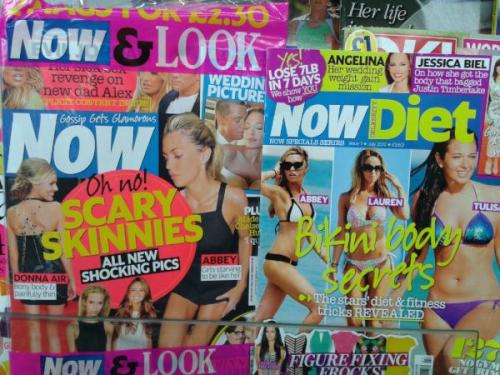
Those three little words became a media sensation a few years back and people started to discuss the sizes of popular models, of 'worryingly thin' celebrities, and the existence of Size 0 clothing. Were they the cause of eating disorders in young women? What should be done about it? Week after week, magazines published the latest updates on the main celeb offenders, who seemed to hang out together, favour the same styles, and were often connected to Rachel Zoe. But what started out as concern over health and wellbeing soon became another stick to beat women with. Young women with eating disorders became stereotyped as silly girls trying to emulate sillier celebrities, thin women found themselves sneered at as "not what men want", and the appearance of women in the spotlight was picked over at every opportunity. In the meantime, nobody really cared about size 0 at all. Which leads us on to...

Real Women

They have curves, apparently. No man wants to have sex with someone who "looks like a 12 year old boy". But wait - "curvy" is so loaded that it can also be construed as a euphemism for "fat" and therefore might be offensive. How about magazines try to make us all feel better by interviewing men about what physical attributes they really want from women? That'll work. How about the nastier women journalists write columns sniping about thin women? In the end, it becomes apparent that what the media means when it talks about attractive curves is "larger than average breasts". And so the conclusion is reached. Real women look like Kelly Brook. Fast forward a few years and it's still happening (thanks to a rash of annoying Facebook groups and memes), but the papers talk about Christina Hendricks instead, and "curvy" means "size 10".

Having It All

This one rears its ugly head in the Daily Mail every couple of weeks as a way of berating women for daring to want children AND a job. But recently the "debate" has gone mainstream again, thanks to Anne-Marie Slaughter and a number of other well-known names weighing in on the supposedly failed dream. Thousands of women have collectively rolled their eyes and wondered why the way the media frames this issue doesn't actually apply to 90% of us, as if it's all about being the perfect mother as well as a banker or a politician. And of course anti-feminists and conservatives seize the opportunity to crow about how unhappy and unfulfilled these liberal times have made women feel. Meanwhile, most of us continue going out to work because we don't have any choice in the matter.

Feminism: compatible with makeup, shaving, and liking men?

In recent years, a popular feature idea to wheel out for International Women's Day, usually disguised as a missive about the state of modern feminism and illustrated with a picture of a burning bra. So repetitive is the format that you wonder what readers are left thinking about the fight for gender equality, and also what harm it would really do to discuss it in terms of things that aren't lipstick and sex. Patronising, short-sighted, and cliched, reducing gender equality to a list of things you can and can't do, and never failing to leave some people with the impression that feminists hate women who wear dresses and like baking, which in itself has become another tedious "debate".

Mommy wars

Currently taking the form of drama over how long it's appropriate to breastfeed for. Such has the animosity over which childbirth and parenting choices a woman makes increased that a mere mention of the way you do things is enough to make some people feel you're judging them for not doing the same. Some of the most weirdly drama-filled and vicious debates I've seen between women online have been about birth and parenting choices, and guilt-tripping or sensationalist news stories don't help matters, constantly painting some choices as bizarre and abnormal, some as neglectful, and others as "the latest trend". Motherhood is enough of a minefield of emotions without all this, thanks very much.


Blog Design by Nudge Media Design | Powered by Blogger